
The formula is straightforward: OTE = annual base salary + variable pay at 100% quota attainment. So if a job offers a $60,000 base with a $40,000 commission target, your OTE is $100,000. That number is a projection, not a promise. Whether you actually earn it depends entirely on your performance and the company's quota design.
- OTE is most common in sales, account management, and some marketing roles
- The base portion is guaranteed (subject to employment); the variable portion is conditional
- "On-track earnings" is used interchangeably with on-target earnings in some job ads
Key Takeaways
| Point | Details |
|---|---|
| OTE formula | Base salary + variable pay at 100% quota = OTE; the base is guaranteed, the variable is not. |
| Red flags to watch | Low base relative to OTE, vague quota definitions, and no historical attainment data are the three biggest warning signs. |
| Negotiation priority | Push for a higher base first; it anchors your benefits, 401(k) match, and income floor. |
| Model multiple scenarios | Run the math at 50%, 100%, and 120% attainment before accepting any OTE-based offer. |
| Pay mix signals risk | A 50/50 split means higher upside and higher risk; 70/30 offers more stability and suits earlier career stages. |
Table of Contents
- What OTE salary means and what it includes
- How to calculate your OTE step by step
- What $80,000 OTE and $25,000 OTE actually mean
- How to evaluate an OTE offer before you accept
- Typical pay mixes by role
- Legal and contractual considerations around OTE
- How OTE affects your taxes and benefits
- How OTE is used in other countries and industries
- Sources
What OTE salary means and what it includes
OTE has two building blocks. The first is your base salary, the fixed amount you receive regardless of performance. The second is your variable pay, the portion tied to hitting specific targets. HR glossaries confirm that only the base is guaranteed; the variable depends entirely on results.
Variable pay counted inside OTE typically includes:
- Commission: a percentage of revenue or bookings you close
- Performance bonuses: structured payouts tied to quota milestones
- SPIFFs: short-term incentive payments for specific products or campaigns
- On-target variable (OTV): the umbrella label some employers use for the full variable component
What OTE usually excludes is equally worth knowing. Equity grants, signing bonuses, relocation allowances, health benefits, and most one-off discretionary bonuses sit outside the OTE figure. Some employers fold an annual performance bonus into OTE; others don't. Always ask which bonuses are included before comparing offers.
Capped vs. uncapped OTE matters for upside. A capped plan limits your total variable pay regardless of how much you overperform. The Cambridge Dictionary defines OTE as the amount you should be able to earn if you meet employer-stated targets, which is exactly why the cap question changes the real value of any headline number.
How to calculate your OTE step by step
The math is simple. The complications come from timing and quota structure.
- Identify your annual base salary. This is the fixed number in your offer letter.
- Find the at-target variable amount. This is what you'd earn in commissions or bonuses at exactly 100% quota. Some offers state it directly; others give you a commission rate and a quota, so multiply them.
- Add the two figures. Base + variable at 100% = OTE.
For example: $50,000 base + $50,000 variable target = $100,000 OTE. Salary use this same additive approach and show how attainment scenarios change realized pay.
Special cases to know:
- Prorated OTE: If you start mid-year, your OTE and quota are typically prorated to the remaining months. A $120,000 OTE role starting July 1 means roughly $60,000 is your realistic ceiling for that calendar year.
- Tiered payout curves: Some plans pay a lower commission rate below quota and a higher rate above it. Your realized pay at 80% attainment may be disproportionately lower than 80% of OTE.
- Accelerators: Optymyze notes that accelerators and decelerators materially shift realized earnings away from the advertised OTE, in either direction.
Payout timing also affects cash flow. Some plans pay commission monthly, others quarterly, and some annually. A quarterly plan means a slow Q1 doesn't pay out until March or April, which matters for budgeting.
What $80,000 OTE and $25,000 OTE actually mean
$80,000 OTE example (Account Executive, 50/50 split):
The $80,000 headline only materializes if you hit quota exactly.
$25,000 OTE example (two variants):
A base-heavy version might be $20,000 base + $5,000 variable. A variable-heavy version might be $12,500 base + $12,500 variable. Both advertise $25,000 OTE, but the first gives you far more income certainty. For early-career candidates, the base-heavy structure is usually the safer starting point.

Is a very high OTE a red flag? It can be. CaptivateIQ's guidance flags a very low base relative to OTE as a warning sign, especially when the company won't share historical attainment data.
Quick red flags:
- OTE is more than 3x the base salary with no attainment data offered
- Quota is defined vaguely or changes frequently
- High turnover in the role
- No ramp period for new hires
How to evaluate an OTE offer before you accept
Before signing, run through this checklist with the recruiter or hiring manager:
- What is the exact base salary?
- What is the variable target amount, and how is it calculated?
- How is quota defined? (Bookings, recognized revenue, contracted ARR?)
- What is the payout schedule? (Monthly, quarterly, annual?)
- Is the variable component capped?
- What percentage of reps hit 100% of quota last year?
- Is there a clawback policy if a deal cancels after commission is paid?
- Is there a ramp quota for the first 90 days?
That sixth question is the most valuable one. CaptivateIQ recommends requesting historical attainment rates as the single best indicator of whether the OTE is realistic. A company that refuses to share this data is telling you something.
Negotiation tactics worth using:
- Push for a higher base first; it's guaranteed and compounds into benefits calculations
- Request a guaranteed minimum draw for the first 60–90 days while you ramp
- Ask for ramp quotas (reduced targets in early months) to protect income during onboarding
- If accelerators exist, ask for the exact rate and the threshold that triggers them
Pro Tip: Ask HR how variable pay is treated for benefits purposes. In many US plans, 401(k) matching is calculated on base salary only, not OTE. That gap adds up over time.
Typical pay mixes by role
Pay mix describes the ratio of base to variable within OTE. It signals both income stability and how aggressively the company expects you to sell.
| Role | Typical Pay Mix (Base:Variable) | What It Signals |
|---|---|---|
| Account Executive | ~50/50 | High performance pressure; strong upside |
| Sales Development Rep | ~70/30 or 60/40 | More stability; earlier career stage |
| Enterprise Sales Rep | ~50/50 or 60/40 | Longer cycles; higher base to reflect complexity |
| Sales Engineer | ~70/30 or 80/20 | Primarily technical; variable tied to team quota |
| Account Manager | ~60/40 | Renewal and expansion focus; moderate variable |
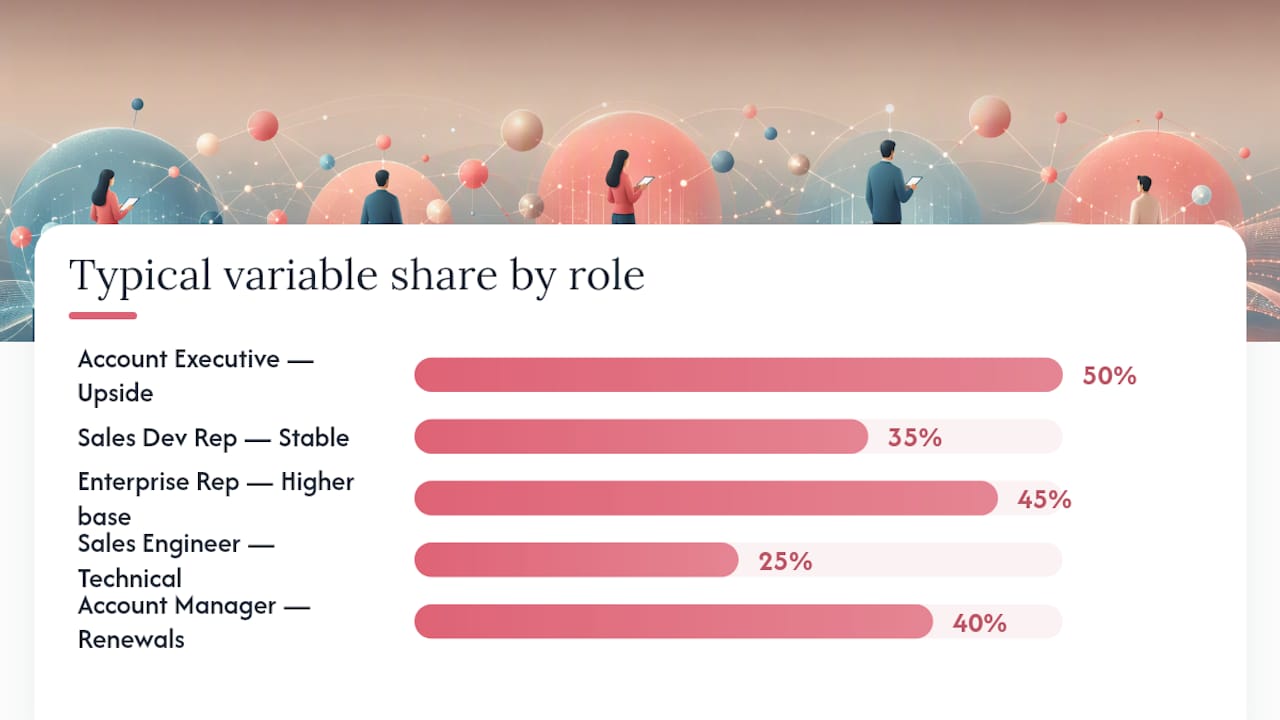
Keka HR confirms that AE roles commonly use a 50/50 split while SDR roles lean more base-heavy at 70/30. Optymyze adds that startups and high-growth firms often push toward larger variable components to conserve cash while offering higher upside.
A 50/50 split at a Series A startup carries very different risk than a 50/50 split at a publicly traded company with extensive quota data history. The pay mix ratio alone doesn't tell you enough; the company's stage and quota history complete the picture.
Legal and contractual considerations around OTE
OTE is not a legally binding earnings guarantee in the United States. It's a projection. Your employment contract will specify your base salary and the terms of your commission plan, but the OTE figure in a job ad carries no legal weight on its own.
What does matter legally is the commission plan document itself. Several US states, including California, Illinois, and New York, require employers to provide written commission agreements before work begins. If you're in one of those states, ask for the plan in writing before your start date, not after.
Clawback clauses are another contractual reality. Some plans allow employers to recover commission already paid if a deal cancels within a set window. Read the plan document carefully for any language around "charge-backs" or "clawbacks" before you accept.
How OTE affects your taxes and benefits
Variable pay is taxed as ordinary income in the United States, but the timing of withholding can feel jarring. You won't know your actual tax liability until you file.
Benefits contributions are often calculated on base salary alone. Health insurance premiums, 401(k) employer matches, and life insurance coverage amounts frequently use base pay as the reference figure, not OTE. That means a role with a $40,000 base and $40,000 variable target may give you the same benefits package as a $40,000 salaried role, even though your OTE is double.
If you're comparing two offers with similar OTE figures, run the benefits math on the base salary, not the headline number.
How OTE is used in other countries and industries
In continental Europe, the concept exists but the acronym is less common; French and German job ads more often state a fixed salary plus a variable component separately.
In the US, OTE is most concentrated in B2B software sales, SaaS, financial services, and recruiting. It's less common in retail, healthcare, and government roles, where compensation structures tend to be fixed or tied to union agreements. Some marketing and content roles, particularly those tied to revenue or lead generation, are beginning to adopt OTE structures as companies tie more of marketing compensation to pipeline outcomes.
What OTE really tells you about a job offer
Most candidates read OTE as a salary figure. It's more useful to read it as a bet. The company is saying: if you perform at the level we expect, here's what you'll earn. The real question is whether that bet is fair.
The number on the job ad doesn't tell you which situation you're walking into.
My advice: model four scenarios before you accept any OTE-based offer. If it isn't, negotiate a higher base or walk away. The upside of a high OTE means nothing if the floor is too low to cover your expenses.
For early-career candidates in social media, content, or marketing, a higher base with a smaller variable component usually makes more sense than chasing a large OTE number. You're still building your track record, and income stability matters more at that stage than theoretical upside. Samssocialmediaclub lists roles with transparent salary ranges so you can see the base and variable split before you apply, which removes the guesswork entirely. If you want curated roles with honest compensation data, reach out through the enquiry page.
Sources
- OTE in Sales – Salaries, Definitions & Commission Pay
- OTE | Cambridge Dictionary
- OTE salary calculation and pay mix guidance | Optymyze
- Salary